

My life as a 13-year-old on IRC in 1993
David Kirby recalls IRC, dial-up bulletin boards, ANSI art, and the communities that shaped his teenage years.
Before browsers and hyperlinks, Internet Relay Chat was where the world came to talk.
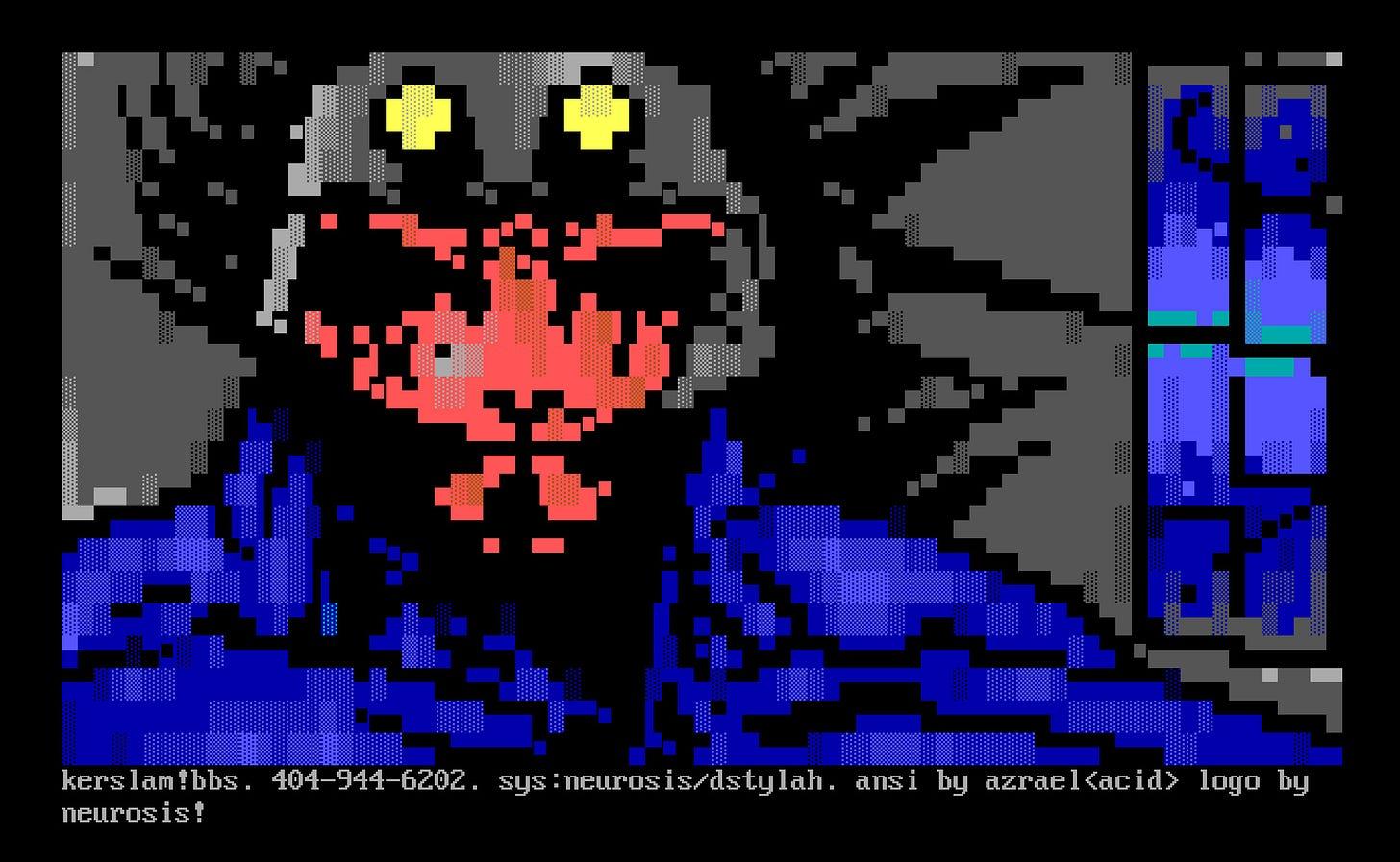
When I first logged onto IRC in 1993, at age thirteen, it felt like a cathedral built out of text.
My parents, devout and wary of “secular culture,” rationed me to PBS for two hours a day and Saturday morning cartoons. But IRC was a channel they couldn’t imagine, let alone forbid. Somehow my ultra-conservative guardians failed to see the dangers of the Internet, so they had no clue I was trolling channels on a hacked SLIP/PPP account (thanks, Ma’ Bell), talking for hours with the strangest congregation on earth: Stanford grad students, Finnish hackers, trackers, and some guy named Kevin on house arrest.
They didn’t know what IRC was, or what a Renegade BBS was (see link to Jason Scott’s incredible BBS documentary below), or that my neighbor helped me phreak a 1-800 number into my bedroom (they did know not to touch that line). They also didn’t know that same neighbor spent most of his time coding viruses—fun, not profit.
A living room in text
So IRC wasn’t just my channel. It was my living room. Dozens of handles tumbling by, juvenile jokes, flame wars, flirtations, futurism, transhumanism, and kickbots. Everyone knew everyone else, and nearly all of us were riding the same hacked Netcom account (thanks lord pegasus).
Alongside the chat, whole art forms were mutating. I started making ANSI art—those 16-color text murals—for the big groups: ACiD, FiRE, and UNiON. Looking back, it still amazes me that they tolerated a kid in their ranks. But that was the magic of the medium: meritocracy rendered in pixels and pipes. If you could draw, code, compose, or release, you belonged.
The channel and the message
And each channel had its own flavor. #ansi was the watering hole for text artists trading palettes and packs. #trax was alive with music trackers, constructing beats block-by-block, vertical columns of hex numbers scrolling by as sound. #demoscene was a rotating stage for people squeezing symphonies and fractals into floppy-disk-sized performances. These weren’t just hobbies, they were incubators.
All of it was channeling. The narrow bandwidth—80 columns, 16 colors, kilobytes of RAM—forced people to shape ideas to the medium. The channel dictated the message, and in turn, the community.
But nothing lasts forever. By the mid-90s, IRC had waned in popularity as the crowd drifted toward a new spectacle—the web. Where IRC channels had been narrow, disciplined, and alive with constraint, the World Wide Web arrived sprawling, colorful, and unbounded. The stage was about to change, and the culture with it.
